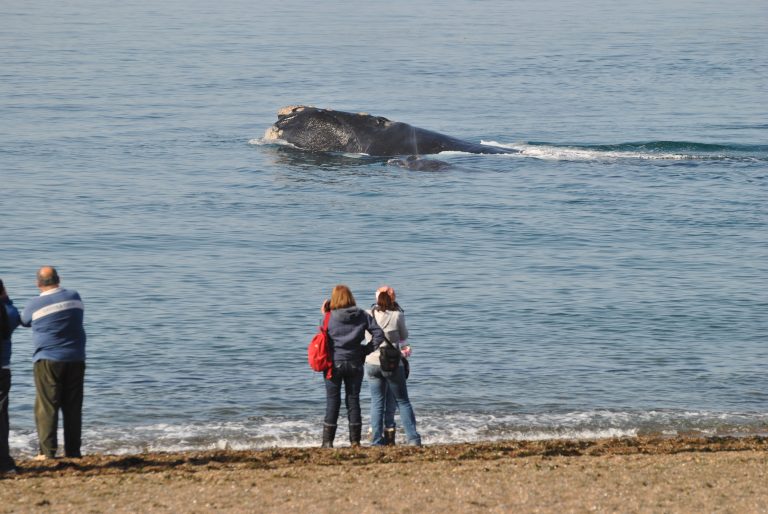
There are moments in travel that stay with you forever. For me, one of those moments happened in September at Playa El Doradillo, just a few kilometers from Puerto Madryn, when for the first time I found myself face to face — or rather, just a few meters away — from a Southern Right Whale and her calf.
It all began early in the morning. I left my hotel in Puerto Madryn while the sun was still low on the Atlantic horizon. The air had that dry chill that is so typical of Patagonia in spring. September is a special month in this region: winter begins to retreat, yet the weather still carries that wild Patagonian character that makes the landscape feel more raw, more authentic.
The drive to El Doradillo takes only about 15 to 20 minutes from downtown Puerto Madryn. The road follows the edge of the Nuevo Gulf, and as you move away from the city the landscape becomes increasingly open. The Patagonian steppe appears in shades of ochre, yellow and gray, interrupted by low shrubs that have learned to survive the constant wind.
That morning the sky was completely clear. A deep blue, almost perfect. The sea, however, had a more complex color: a mix of deep blue and dark green that shifted with every movement of the light. When we arrived at the entrance to Playa El Doradillo, the guide asked us to walk slowly toward the shoreline. I still hadn’t seen anything. But the silence of the place already suggested that something special was about to happen.
El Doradillo is one of the few places in the world where Southern Right Whales (Eubalaena australis) naturally approach the shore. It is not unusual to see them less than 10 or 20 meters from the beach, something that is practically impossible in most whale-watching destinations. And September is precisely the perfect moment to witness something even more extraordinary: mothers with their newborn calves.
Puerto Madryn & Peninsula Valdes – 3 night traditional program
Check best season to see whales and penguins in the area
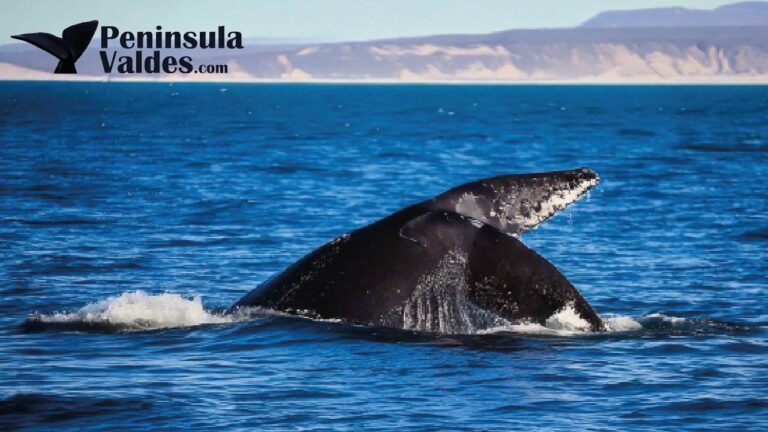
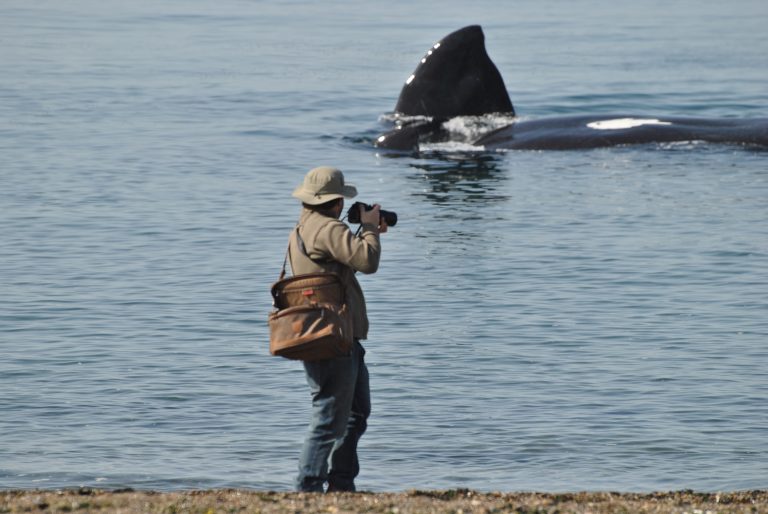
When we finally reached the beach, the scene unfolded before us. About 30 meters from the shore, a massive dark shape broke the surface of the water. First came the blow. That characteristic V-shaped spout, the unmistakable signature of the Southern Right Whale. It can rise several meters into the air and occurs when the whale expels warm air from its lungs as it comes up to breathe.
Then the back emerged. Huge. Smooth. Shiny black under the sun. And then, right beside it, something smaller appeared. The calf. An awkward, curious movement, still learning how to move through the ocean. It was impossible not to remain silent.
Every year Southern Right Whales arrive at Nuevo Gulf and San José Gulf, in Península Valdés, to reproduce and give birth to their calves. This process takes place between June and December, but September is one of the most active months because many calves have already been born.
Calves are born measuring approximately 4 to 5 meters in length and weighing around 1,500 kilograms. Even so, compared to their mothers they seem small.
Adult females can reach 15 meters in length and weigh more than 40 tons.
From the beach we watched as the mother moved slowly through very shallow water. This behavior is not accidental: whales use these protected areas to care for their young, far from predators and in calmer waters. The calf swam around her. Sometimes it seemed to hide beneath her enormous body. Other times it surfaced and breathed with a small and still somewhat irregular blow.
One of the most fascinating aspects of their biology is their growth rate. During the first months of life, a calf can gain up to 3 kilograms per hour, feeding exclusively on its mother’s milk, which contains more than 40% fat. That means that within just a few weeks the calf begins to gain the strength needed to accompany its mother on long migrations.
Puerto Madryn Whale Watching Tour at Doradillo Beach
Immerse yourself in unforgettable Puerto Madryn whale watching tour. Witness majestic whales up close on expert-guided adventures.
From Price: USD 115
As we observed from the beach, the sea was surprisingly calm. Small waves gently broke against the sand. The Patagonian wind, which usually plays a major role in this region, seemed to have taken a break that morning. The dominant sound was the water, and every now and then the deep blow of the whales. At one point something happened that I still remember with perfect clarity. The calf began to play. It approached the surface and lifted one of its small pectoral fins out of the water. Then it gently slapped the sea. Again and again. Scientists believe these behaviors may be part of learning or even a form of communication between mother and calf. Southern Right Whales are extremely social animals and use complex vocalizations to communicate underwater. Although we could not hear those sounds from the beach, we knew that mother and calf were probably exchanging signals constantly.
We remained there for a couple of long hours, enriched by a wonderful breakfast. There was coffee, medialunas, sandwiches, and mate as well — mate can never be missing. And the enjoyment became absolutely unforgettable. I asked my guide everything I could about the life of these incredible animals. I was particularly intrigued by the white patches on the whale’s skin, and by some birds that seemed to be approaching it.
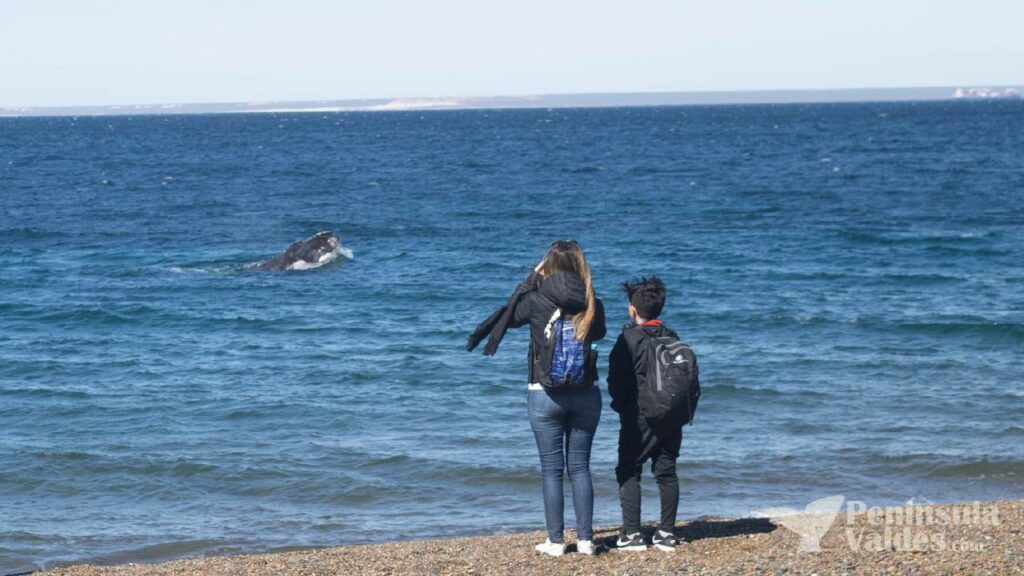
Then the head slowly emerged… and there they were, those irregular white patches. At first I thought they were scars or marks on the skin. But in reality they are something far more fascinating. They are called callosities.
Callosities are areas of thick, rough skin that Southern Right Whales have mainly on their heads: on the rostrum, around the eyes, on the chin and on the top of the skull. Each whale has a unique pattern, like a fingerprint. In fact, scientists use those marks to identify individual whales and follow their lives for decades. What makes those areas appear white is not the skin itself, but thousands of small organisms that live there. They are small crustaceans called cyamids, popularly known as “whale lice.”
They are not harmful parasites; rather, they live on the surface of the skin feeding on organic remains. As they accumulate on the callosities they create that pale coloration that contrasts with the deep black of the whale’s body.
Once you know this, looking at those patches completely changes the experience. They are no longer just marks: they are almost a biological map, a way to recognize each individual. While I watched the whale that morning, another scene also unfolded that made me think. Several seabirds began to approach. First came a kelp gull, descending in circles. Then another. Suddenly there were several flying very close to the whale’s head. At times they rested on the water around her, waiting. And at other moments they did something that can be surprising the first time you see it: they gently pecked at the whale’s skin. Gulls in Patagonia have learned to feed on small portions of skin or superficial fat when the whale surfaces to breathe. This behavior has become more frequent in some areas of Península Valdés.
From the beach, watching that scene, one clearly perceives the complex relationships that exist within the marine ecosystem. The whale appears enormous and invulnerable, yet even a giant of the ocean constantly interacts with other species. What is interesting is that the whale often does not react aggressively. It simply submerges slowly or changes position. In other cases it may slap the water with its tail or move away to avoid the birds. As I watched all of this, I realized something that always impresses me about these encounters: when you remain still and observe patiently, you begin to discover the small details of these animals’ lives.
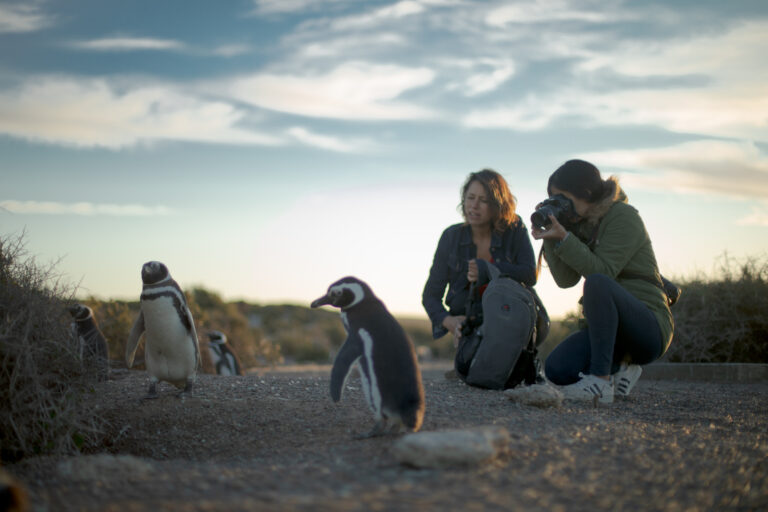
Adventure in Peninsula Valdés with Brunch
Enjoy a full-day adventure through Peninsula Valdés and its rich natural environments. Discover wildlife such as penguins, sea lions, and elephant seals.
- Peninsula Valdes
From Price: USD 249
The callosities that allow scientists to identify each whale. The crustaceans that live on their skin. The birds flying nearby waiting for an opportunity. The rhythmic blows every few minutes. The calm movements of a mother caring for her calf. From the beach, just a few meters away, all of this unfolds in silence, as if the ocean were revealing an intimate fragment of its life.
The sun slowly climbed higher and the colors of the landscape began to change. The water shifted from that initial deep green to lighter tones, almost turquoise near the shore. The sand reflected the light with a golden glow that contrasted with the deep blue of the Patagonian sky. At that moment I understood why this place is called El Doradillo.
There was something deeply moving about being there. There were no boats. No engines. No human noise. Just us, the beach, the gentle wind… and these giants of the ocean living their daily lives. Unlike boat-based whale watching — which is also extraordinary — the experience here is different. More intimate. Quieter. More natural. You are at the same horizon line as they are. You see them breathe. Move. Care for their calves. And for a moment, you feel that you are witnessing something that has been happening in exactly the same way for thousands of years.
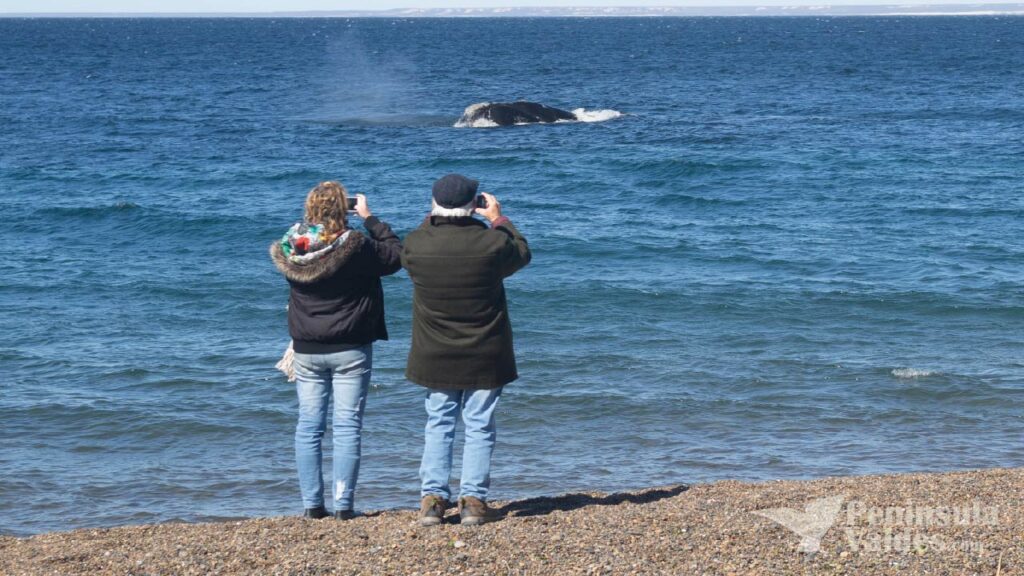
Before returning to the vehicle, I looked one last time toward the sea. The mother was floating almost motionless. The calf continued moving around her, curious, restless, full of energy.
And I thought about something that always amazes me about these animals: after spending several months here raising their calves, the whales will undertake a migration of thousands of kilometers toward the cold waters of Antarctica, where they feed on krill during the austral summer.
An epic journey. One of the great natural cycles of our planet.
When we finally returned to Puerto Madryn, I felt that I had experienced something far deeper than a simple excursion. It had been an encounter. A powerful reminder of how extraordinary life on our planet truly is. And that sometimes the most remarkable moments happen simply standing on a beach, looking out at the sea, while a whale and her calf pass just a few meters away.
Puerto Madryn – 2 night traditional program
Check best season to see whales and penguins in the area
Did you enjoy my story? Feel free to contact me at info@ripioturismo.com. I will be ready to help you organize your trip.
Puerto Madryn Whale Watching Tour at Doradillo Beach
Immerse yourself in unforgettable Puerto Madryn whale watching tour. Witness majestic whales up close on expert-guided adventures.
From Price: USD 115