Burrowing owls are one of the most approachable-looking birds of the Patagonian steppe—and one of the easiest to disturb unintentionally. Unlike most owls, they spend much of their time on or close to the ground, often standing upright near a burrow entrance, fence post or low roadside perch. In Península Valdés, patient travelers may see them in open areas with short vegetation, but there is no official guaranteed viewing point.
The best observation method is simple: scan from a vehicle, recognize the signs of an occupied burrow, keep a generous distance and let the owl choose whether to remain visible. This guide focuses on field identification, habitat, behavior and ethical photography rather than disclosing a vulnerable nest location.
How to identify a burrowing owl
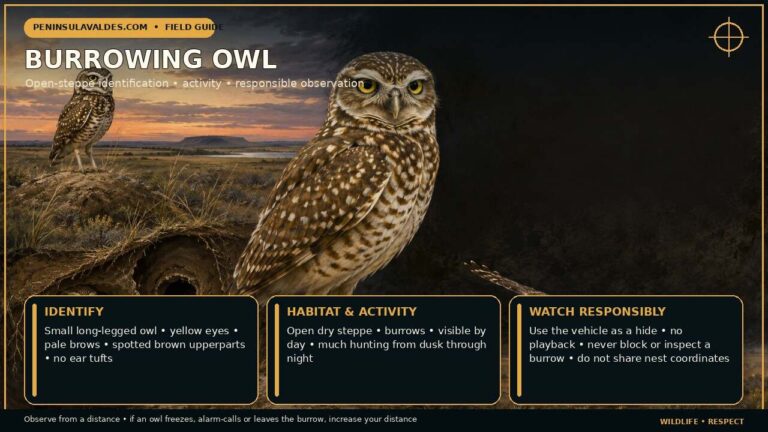
The burrowing owl (Athene cunicularia) is small, long-legged and compact, with a rounded head and no ear tufts. Adults have bright yellow eyes, a pale eyebrow, a white throat patch and brown upperparts spotted with white. The breast is barred or mottled. Its upright ground posture is distinctive: the bird can look almost sentinel-like as it watches the surrounding steppe.
Juveniles are plainer and may show a buff-colored breast. Young birds often remain close to the family burrow, so several small owls together should be viewed from even farther away.
| Observation | Likely meaning | Your response |
|---|---|---|
| Standing calmly, preening or hunting | Tolerating your current position | Stay still; do not move closer |
| Repeated head-bobbing or fixed stare | Heightened attention | Reduce movement and increase distance |
| Alarm calls, crouching or short flights | Disturbance near territory or burrow | Leave promptly and quietly |
| Adult carrying prey toward a burrow | Possible active nest or chicks | Do not wait beside the entrance |
Birdwatching Whole Day Tour
Embark on a full-day birdwatching adventure in Patagonia, discovering the diverse avian species of the Peninsula Valdés region.
- Puerto Madryn
From Price: USD 1290
Where do burrowing owls live in Península Valdés?
They favor open, dry country with sparse or low vegetation and enough visibility to detect prey and danger. Suitable habitat occurs across the steppe of Península Valdés and around the wider Puerto Madryn–Rawson region. Roadside verges, grazed fields, sandy ground and low embankments may all contain burrows, but a roadside sighting does not mean the shoulder is safe for parking.
Scan first for a small upright silhouette. Fence posts and low mounds make useful perches. An occupied burrow may have pellets, feathers, prey remains or droppings nearby, but visitors should never walk over to inspect these clues. The entrance and surrounding ground are part of the owl’s living space.
Do burrowing owls dig their own burrows?
The species is named for its underground nesting and roosting habit. Depending on local soil and available structures, burrowing owls may excavate, enlarge or reuse holes made by other animals. A burrow provides shade, shelter from wind and a protected place for eggs and chicks. The underground nest makes low-profile disturbance particularly risky: a person may stand on a tunnel or block the only clear approach without realizing it.
Never insert a camera, stick or phone into an entrance. Do not move stones, vegetation, bones or pellets around the burrow. A “better view” is not worth changing the structure or scent of the site.

When are they active?
Burrowing owls are often visible by day, especially during cooler hours, but research in the arid lands of northeastern Patagonia indicates that much hunting takes place at night. Dawn and late afternoon can therefore combine good visibility with natural activity. During the hottest part of a summer day, an owl may stay close to shade or below ground.
The diet is generalist. Insects, arachnids and small vertebrates all contribute, with local and seasonal variation. Pellets near a burrow are valuable biological evidence, not souvenirs.
The site’s general birdwatching guide to Península Valdés provides the wider bird context. This article adds the ground-level observation method and nest-sensitive behavior needed specifically for burrowing owls.
How to watch without changing their behavior
- Use the vehicle as a hide. Owls may accept a stationary vehicle more readily than a person walking toward them.
- Choose legal, visible pullouts. Do not stop on a blind curve or soft shoulder.
- Start with binoculars. Confirm the bird’s position before raising a camera.
- Keep voices low and movements slow. Several people exiting at once can trigger flight.
- Avoid playback. Recorded calls can provoke territorial responses and waste energy.
- Do not publish precise nest coordinates. Location sharing can multiply disturbance.
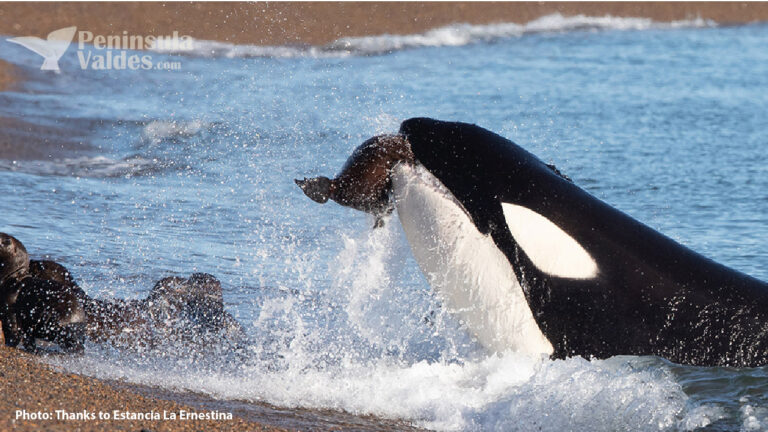
Orca Hunting in Peninsula Valdes: Estancia La Ernestina
Enjoy the amazing orca at the beaches of La Ernestina between March and May every year
Photography settings and composition
A telephoto lens in the 300–600 mm range is useful because the ethical distance is often greater than beginners expect. Use a fast shutter speed for takeoff or hunting and a lower angle only when it can be achieved from an established public position—never by crawling toward a burrow. Include low scrub, soil and sky to show why this owl is adapted to open Patagonia.
Watch the bird between bursts. If it stops feeding, freezes, repeatedly turns toward you or retreats underground, photography has already become pressure. Back away before trying another frame.
My practical advice is to judge a sighting by the owl’s behavior, not by the focal length of the photograph. If the bird continues its normal routine while you observe, the encounter is more successful than a close portrait obtained by forcing it to react.
Why responsible observation matters
Burrowing owls live at the intersection of wildlife habitat and working landscapes. Vehicles, road maintenance, dogs, trampling and repeated approach can affect individual sites. Their visibility makes them excellent ambassadors for the steppe, but it also makes active burrows easy targets for excessive attention.
A quiet observation from the road can reveal hunting, sentinel posture, pair behavior and family life without crossing the invisible line around a nest. Bring binoculars, accept distance and keep the exact burrow where it belongs: in the landscape, not on a public map.
If birdwatching is an important part of your trip, we can help design a route that combines coastal colonies with steppe habitats while respecting reserve rules and wildlife-sensitive stops.
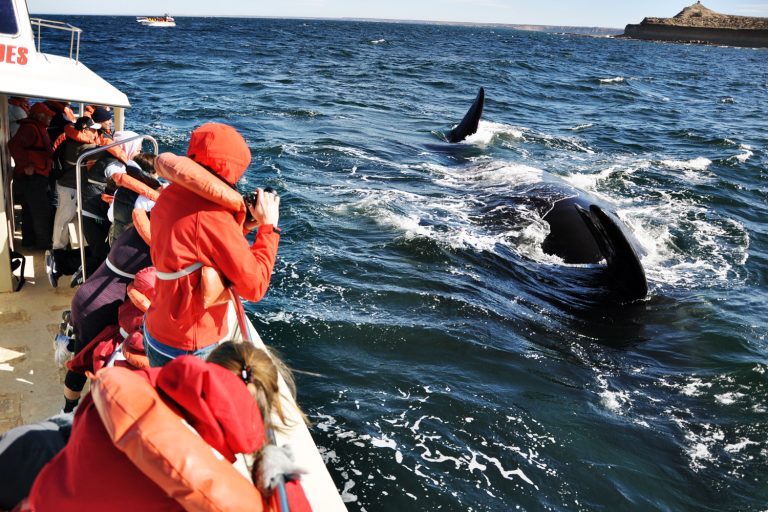
Puerto Madryn & Puerto Piramides – 4 nights
Check best season to see whales and penguins in the area
Puerto Madryn & Ushuaia
Check best season to see whales and penguins in Puerto Madryn and Peninsula Valdes area