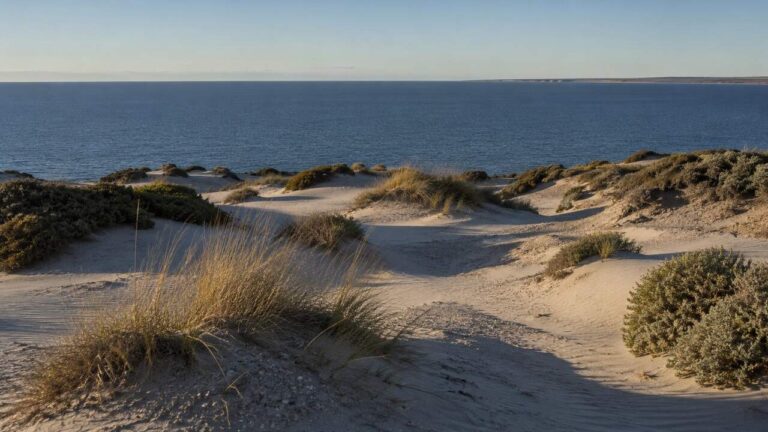
The dunes of Península Valdés are not empty piles of sand. They are moving landforms built by wind, supplied by beaches and gradually stabilized by vegetation. Together they store sand, buffer parts of the coast and provide specialized habitat. Tire tracks and repeated foot traffic can break that system quickly, which is why authorized routes matter.
How a coastal dune begins
Waves deposit sand on a beach. When grains dry, persistent Patagonian winds move them inland by rolling, bouncing and suspension. Small obstacles—driftwood, stones or pioneer plants—slow the wind and trap grains. Repetition creates an embryo dune, then a ridge. Some dunes remain mobile; others become partly fixed as vegetation increases.
From beach to stabilized dune
| Zone | Process | Sensitivity |
|---|---|---|
| Upper beach | Dry sand becomes wind transport | Vehicles interrupt exchange |
| Fore-dune | Pioneer plants trap new sand | Footpaths fragment vegetation |
| Mobile dune | Wind reshapes exposed ridges | Tracks alter airflow |
| Fixed dune | Shrubs and grasses bind surface | Slow recovery after damage |
Plants are ecosystem engineers
Dune plants tolerate salt spray, drought, burial and abrasive wind. Their roots and stems reduce sand movement locally and create shelter where insects and other plants can establish. Removing one patch can open a corridor that channels wind and expands erosion.
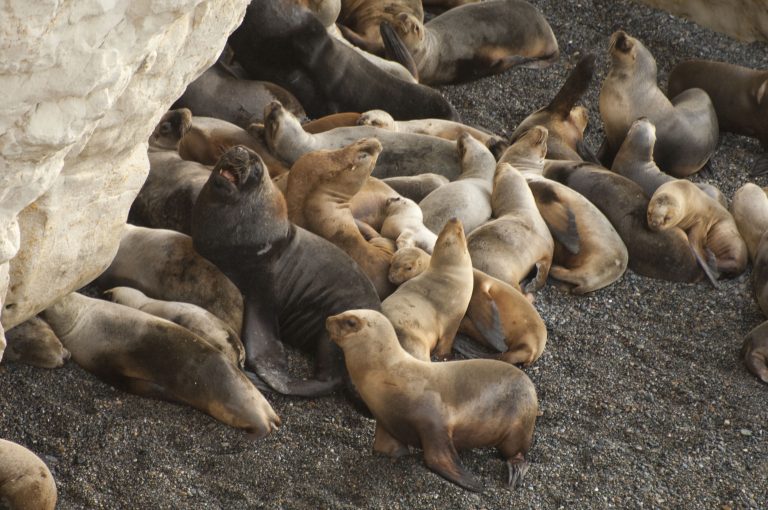
Cerro Avanzado Tour From Puerto Madryn
Unforgettable adventure: Encounter sea lions, enjoy panoramic views, and explore Cerro Avanzado's beauty. Book now!
- Adventure
From Price: USD 115
Why dunes move—and why that is not always damage
Natural dune migration is part of the system. A mobile ridge can advance, retreat or change shape with wind regime and sand supply. Problems arise when roads, buildings, extraction or intensive recreation block transport or destroy stabilizing cover. Management must distinguish natural movement from human-triggered erosion.
Wildlife in a seemingly sparse landscape
Tracks may reveal insects, lizards, small mammals and birds that use open sand, vegetated hollows and the transition to steppe. Ground-nesting birds are especially vulnerable to off-trail walking and dogs. Never approach a nest or use a drone to search for wildlife.
Travelers sometimes judge a route by the closeness of the view. In fragile dunes, the best viewpoint is often the established trail or road. Remaining on it protects the very pattern the visitor came to photograph.
How to visit without weakening the dunes
- Use signed roads, boardwalks and established paths.
- Never drive on dunes unless a specifically authorized activity permits it.
- Avoid vegetation, even when it looks dry or dead.
- Do not slide, dig or remove sand and plants.
- Keep dogs out of protected wildlife areas.
- Carry out all waste.
Understanding dune dynamics transforms the landscape: every ripple records wind, every plant patch influences deposition and every responsible route choice helps keep the system connected.
Puerto Madryn – 4 night traditional program
Check best season to see whales and penguins in the area
Puerto Madryn & Puerto Piramides – 3 nights
Check best season to see whales and penguins in the area