Patagonian skunks are among the easiest mammals to overlook in Península Valdés. Most wildlife itineraries focus on whales, penguins, sea lions and guanacos, while this compact black-and-white carnivore is usually noticed only when it crosses a quiet road or searches for insects near low vegetation. Yet the skunk is a characteristic member of the Patagonian steppe and a fascinating animal to observe from a respectful distance.
The animal seen in the region is a South American hog-nosed skunk. Older field guides and much Patagonian literature call it the Patagonian or Humboldt’s hog-nosed skunk, Conepatus humboldtii. Current mammal taxonomy often treats that name within the broader species Conepatus chinga, Molina’s hog-nosed skunk. Travelers do not need to solve the taxonomic debate in the field, but understanding it prevents confusion when different guides or websites use different scientific names.
How to identify a Patagonian skunk
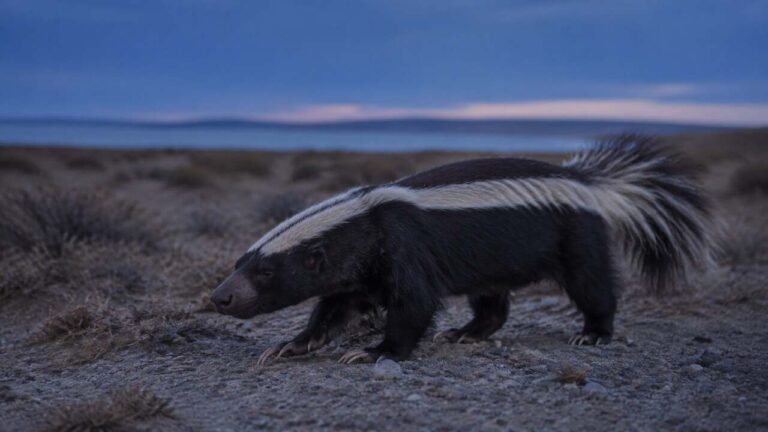
Look first at shape rather than stripe pattern. The body is low, solid and relatively elongated, with short legs, a triangular head and a conspicuous bushy tail. The broad, projecting nose is adapted for rooting through soil and litter. Strong, curved foreclaws help uncover beetles, larvae and other prey.
The dark coat usually carries two pale bands running backward from the head or neck, but the width, continuity and brightness of those bands vary considerably. Some individuals look sharply black and white; others appear dark brown or reddish in warm light. This variation is one reason coloration alone has not provided a simple taxonomic answer.
| Feature | What to notice | Why it helps |
|---|---|---|
| Body | Stocky, low to the ground, short-legged | Separates it from the longer-legged gray fox |
| Head | Small ears and broad, bare-looking nose | Typical hog-nosed skunk profile |
| Coat | Dark fur with two variable pale dorsal bands | Useful, but pattern varies between individuals |
| Tail | Long, conspicuously bushy and often pale-mixed | May be raised during a defensive display |
Puerto Madryn & Puerto Piramides – 3 nights
Check best season to see whales and penguins in the area
What Patagonian skunks eat
Despite belonging to the order Carnivora, these skunks are flexible omnivores with a strong preference for invertebrates. Beetles and other insects can form a major part of the diet, supplemented by small vertebrates, carrion and plant material when available. Their nose and foreclaws make them efficient ground foragers: a skunk may pause repeatedly, sniff, scrape and dig before moving a short distance and repeating the process.
This feeding style explains why an animal may appear absorbed in the ground and seem indifferent to a distant vehicle. That is not permission to approach. It is simply concentrating on a patch of food.
Behavior: quiet until threatened
Patagonian skunks are mainly solitary and are most likely to be active in low-light periods or at night, although daytime sightings occur. Their famous chemical defense is a last-resort system, not their normal response to every encounter. Before spraying, a skunk may stop, turn, stamp, arch its body, raise the tail or present its hindquarters. These signals should be treated as an immediate request for more space.
If you notice defensive posturing, stop moving toward the animal. Remain inside the vehicle when possible, avoid surrounding it and leave an open escape route. A calm retreat protects both the visitor and the skunk.

Where might you see one in Península Valdés?
Skunks use open steppe, low scrub and the edges of areas modified by people. Sightings are possible along quiet roads, around rural properties and near places where insects or improperly stored food waste concentrate. There is no guaranteed skunk viewpoint. Their irregular appearance is part of the reason they remain an overlooked mammal.
Slow wildlife-aware driving is the best practical strategy. Scan the road margins at dawn and late afternoon, but never stop where another vehicle cannot see you. At night, reduce speed substantially: a skunk’s low body can be difficult to detect in headlight glare.
For a broader overview of when different animals are present, compare this guide with the Península Valdés wildlife calendar. Skunks are not a seasonal headline species, so patience matters more than choosing a particular month.
How to photograph a skunk responsibly
- Photograph from inside the vehicle whenever road safety allows.
- Use a telephoto lens and include steppe habitat rather than trying to fill the frame.
- Do not bait the animal or leave food near accommodations.
- Never block its direction of travel.
- Avoid flash at night and do not pursue with headlights.
In more than 25 years of helping travelers plan wildlife trips in Argentina, I have found that the smaller, unexpected encounters often change how people understand a destination. A skunk calmly foraging in the steppe may not produce the drama of a whale breach, but it reveals the living ecosystem between the famous viewpoints.
Birdwatching Whole Day Tour
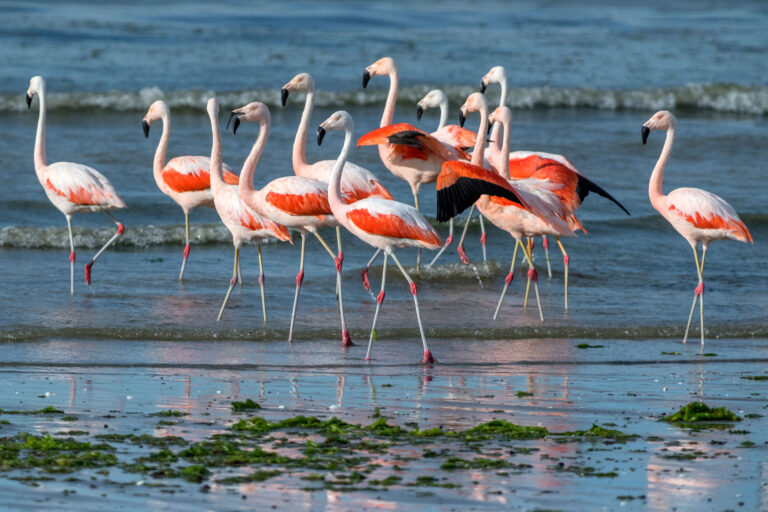
Embark on a full-day birdwatching adventure in Patagonia, discovering the diverse avian species of the Peninsula Valdés region.
- Puerto Madryn
From Price: USD 1290
Why skunks matter in the steppe
By consuming large numbers of insects and scavenging organic material, skunks participate in nutrient cycling and help shape the small-prey community. They are also prey or competitors within the wider carnivore guild. Their presence is therefore connected to foxes, cats, raptors and the health of the ground-level food web.
The most immediate threats visible to travelers are road mortality, harassment, dogs and access to human food. Responsible driving and secure waste management are simple conservation actions with real value.
A small mammal worth noticing
A Patagonian skunk sighting should be treated as an observation, not an interaction. Give the animal room, watch how it searches the ground and appreciate the contrast between its bold warning colors and quiet behavior. Península Valdés becomes a richer destination when visitors look beyond the most famous marine mammals and recognize the full steppe community.
If you would like to build a wildlife itinerary that balances major colonies with slower observation of terrestrial species, our team can help organize the route without promising sightings that nature cannot guarantee.
Puerto Madryn & Puerto Piramides – 4 nights
Check best season to see whales and penguins in the area
Puerto Madryn and Bahia Bustamante – 5 nights
Check best season to see whales and penguins in the area