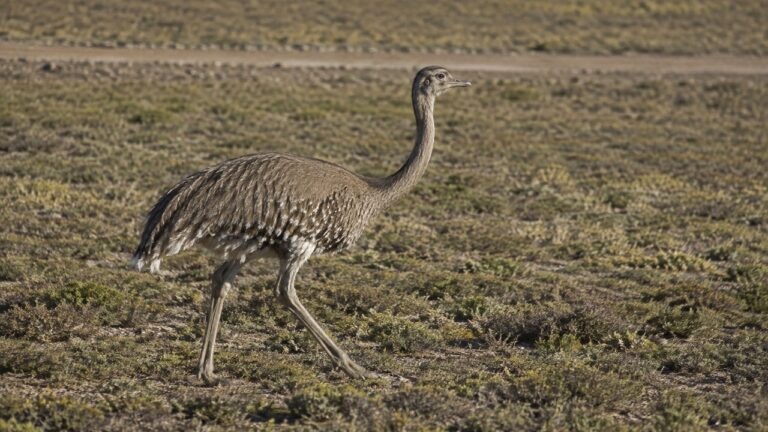
The lesser rhea, known locally as the choique and also called Darwin’s rhea, is the large flightless bird of the Patagonian steppe. In Península Valdés it can appear beside internal roads or moving through open scrub, often in small groups. Its long neck and legs suggest an ostrich at first glance, but the choique is a South American ratite with three-toed feet, brown-and-white-flecked plumage and a remarkable breeding system in which the male incubates the eggs and raises the chicks.
Choique sightings are possible year-round, although group composition and behavior change with the breeding cycle. Drive slowly, scan open country and never force birds to run alongside a vehicle.
How to identify a lesser rhea
An adult lesser rhea stands roughly 90–100 cm tall and commonly weighs about 15–29 kg. The plumage is gray-brown to brown, marked with pale or white flecks. The wings are large for a flightless bird and are used for balance and sudden changes of direction while running.
| Clue | What it tells you |
|---|---|
| White-flecked brown plumage | Typical lesser rhea pattern |
| Three toes | Rhea, not an ostrich |
| Adult followed by many chicks | Usually the caregiving male |
| Wings extended while running | Balance and rapid turning, not an attempt to fly |

Lesser rhea vs greater rhea
The lesser rhea is the expected rhea of the Patagonian steppe. It is generally smaller and more visibly white-flecked than the greater rhea, whose principal range lies farther north and east in grasslands and open country. Location is a powerful identification clue: in Península Valdés, “choique” normally refers to Rhea pennata.
How choiques feed
Choique diet is dominated by plant material, including leaves, grasses and shrubs, with invertebrates and other small food items taken opportunistically. They walk steadily while feeding, pecking at low vegetation. Their height lets them watch over the scrub, but it also makes them visible at considerable distance.
Birdwatching Whole Day Tour
Embark on a full-day birdwatching adventure in Patagonia, discovering the diverse avian species of the Peninsula Valdés region.
- Puerto Madryn
From Price: USD 1290
The male incubates and raises the chicks
The breeding system is one of the best reasons to watch these birds carefully. Several females may lay eggs associated with one male’s nest. The male incubates the clutch for roughly five to six weeks and then protects and leads the chicks. He can become defensive around the nest or young, so greater distance is essential during this period.
If you see an adult followed by a line or cluster of striped young, do not assume it is the mother. In rheas, the attendant adult is normally the male. Never step between the adult and chicks, and do not leave a vehicle to improve the angle.
Groups outside the breeding season
Outside nesting and chick-rearing periods, lesser rheas can be sociable and may form mixed groups. When alarmed, birds may spread out and run in different directions. This can confuse predators, but on a road it creates a serious hazard. Stop well before the birds and let the entire group clear the route.
Where to look in Península Valdés
Scan open steppe and low shrubland along the protected area’s internal routes, especially on long sight lines between the isthmus and the main coastal wildlife sectors. Their neck and upper back may be the only parts visible above vegetation. A stationary bird can disappear surprisingly well into gray-brown scrub.
Passenger scanning is safer than asking the driver to search. Use designated viewpoints and safe pullouts. The peninsula’s road conditions and wind can change, so the wildlife search should never compromise control of the vehicle.
The site’s overview of birdwatching in Península Valdés places the choique within a much broader community of steppe, coastal and marine birds.
Photography tips for choiques
- Use a telephoto lens and leave space in the frame in the direction the bird is moving.
- Choose a fast shutter speed for running birds and chicks.
- Focus on the head or eye when vegetation partly hides the body.
- Make environmental frames showing the scale of the steppe.
- Never provoke a run; a calm walking or feeding image represents natural behavior better.
Birdwatching Whole Day Tour
Embark on a full-day birdwatching adventure in Patagonia, discovering the diverse avian species of the Peninsula Valdés region.
- Puerto Madryn
From Price: USD 1290
Heat shimmer can soften long-distance images over the steppe, especially near midday. Early and late light usually improves color and texture. Photograph from the vehicle when stopping is safe; the vehicle acts as a less disruptive observation shelter than a person walking toward the bird.
For wider camera planning, see the verified guide to wildlife photography opportunities in Península Valdés.
Responsible viewing
- Do not approach nests, eggs or chicks.
- Do not use calls or sounds to make a bird raise its head.
- Keep food contained and never feed wildlife.
- Slow down before passing a group; more birds may be hidden.
- Remain on public roads, marked trails and authorized estancia routes.
I recommend asking guides to include terrestrial wildlife in the day’s interpretation, not only the marine highlights. A guide who reads posture and habitat can show why a bird is alone, why an adult is defensive and when it is better to leave the scene.
A Patagonian bird worth slowing down for
The choique is more than “South America’s ostrich.” Its white-flecked plumage, fast directional running and male-led parental care belong specifically to the open landscapes of Patagonia. Spotting one is rewarding; watching it long enough to understand what it is doing is better.
Puerto Madryn & Puerto Piramides – 4 nights
Check best season to see whales and penguins in the area
Puerto Madryn and Bahia Bustamante – 5 nights
Check best season to see whales and penguins in the area