Commerson’s dolphins are the small black-and-white cetaceans known locally as toninas overas. On the Chubut coast, they are closely associated with shallow marine waters, bays, estuaries and the productive area around Puerto Rawson and Playa Unión. Their bold pattern makes adults easy to recognize, but their biology is more complex than the popular “panda dolphin” nickname suggests.
This article focuses on anatomy, social behavior, habitat use, population structure and conservation. For departure logistics and current tour availability, use the separate Rawson excursion page rather than treating biological presence and commercial operating dates as the same thing.
What is a Commerson’s dolphin?
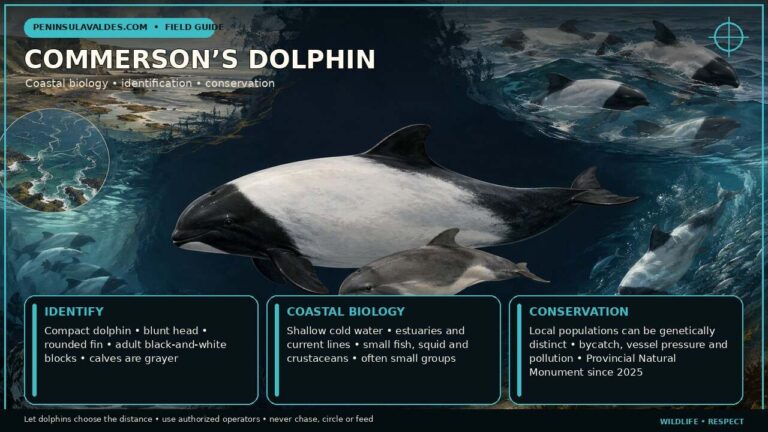
The Commerson’s dolphin (Cephalorhynchus commersonii) belongs to a group of small, blunt-headed Southern Hemisphere dolphins. It has a compact body, rounded flippers, a low rounded dorsal fin and little or no visible beak. Adults of the South American subspecies show a sharply divided black-and-white pattern: the head, flippers, dorsal fin and rear portion are dark, while much of the body is white.

Calves and juveniles are grayer and less strongly contrasted. The adult pattern develops with age, so a pale gray animal swimming beside a black-and-white adult is not necessarily a different species.
| Feature | What to look for | Biological meaning |
|---|---|---|
| Head | Blunt profile with no long beak | Typical of the genus Cephalorhynchus |
| Adult color | Strong black-and-white blocks | Useful at the surface even during short sightings |
| Young animal | Softer gray pattern, often beside an adult | Color contrast increases as the dolphin matures |
| Movement | Fast surfacing, sharp turns, bursts near current lines | Adapted to dynamic, shallow coastal habitat |
Two geographically separated subspecies
Scientists recognize two isolated forms. C. c. commersonii lives around southern South America, including the Argentine coast, the Strait of Magellan and waters around Tierra del Fuego and the Falkland Islands/Islas Malvinas. C. c. kerguelenensis occurs around the Kerguelen Islands in the southern Indian Ocean and differs in size and coloration.
The dolphins of Chubut belong to the South American form. Genetic research shows that populations along southern Argentina can be structured over relatively small geographic scales. In practical conservation terms, dolphins using one coastal habitat cannot automatically be treated as interchangeable with animals hundreds of kilometers away.

Why the Chubut coast suits them
Commerson’s dolphins favor cold, shallow coastal waters and are frequently associated with bays, harbor approaches, river mouths and zones of strong tidal mixing. Bahía Engaño, the Chubut River mouth and adjacent waters around Puerto Rawson provide exactly this combination of depth changes, currents and concentrated prey.
They may use current lines and turbulence as feeding opportunities. Their rapid acceleration and tight turns allow them to pursue small schooling fish and other prey in a physically complex environment. Distribution is patchy rather than continuous: suitable habitat occurs as a network of valuable coastal areas.
What do Commerson’s dolphins eat?
The diet is varied and reflects local availability. Small fish, squid and crustaceans can all be taken. Rather than specializing in one tourist-visible hunting technique, these dolphins adjust to moving prey and changing coastal conditions. Feeding may involve fast chases, sudden direction changes and coordinated movement by several animals.
A boat surrounded by active dolphins is not necessarily seeing play. Bow-riding, social interaction, travel and feeding can look similar during a brief encounter. The responsible interpretation is to describe the behavior visible at that moment without assigning a human emotion to every jump.
Social behavior and calves
Commerson’s dolphins are often seen in small groups, although larger temporary aggregations can form where prey concentrates. Group membership may change as animals feed, travel or socialize. Mothers and calves maintain close coordination, and a young gray dolphin beside a larger adult should be given particular space.
Researchers use photo-identification, genetics, shore-based observation and boat surveys to understand site fidelity and movement. These methods reveal patterns that a single tourism trip cannot: repeated use of habitat, differences between local groups and the seasonal importance of particular coastal sectors.
For the visitor-focused answer to where excursions operate, see Commerson’s dolphin watching from Puerto Rawson. The operator’s current schedule, weather decision and departure confirmation should always override a general wildlife article.
How is this species different from other local dolphins?
Adult Commerson’s dolphins are much more strongly black-and-white than dusky, common or bottlenose dolphins seen elsewhere around the region. Their compact body and blunt head can make them look porpoise-like, but they are true oceanic dolphins in the family Delphinidae.
Location also helps. Around Rawson, a small, sharply piebald dolphin is strongly suggestive of a tonina overa. In Golfo Nuevo, travelers may encounter other dolphin species on marine excursions. Identification should combine pattern, body shape and place rather than rely on one fleeting glimpse.
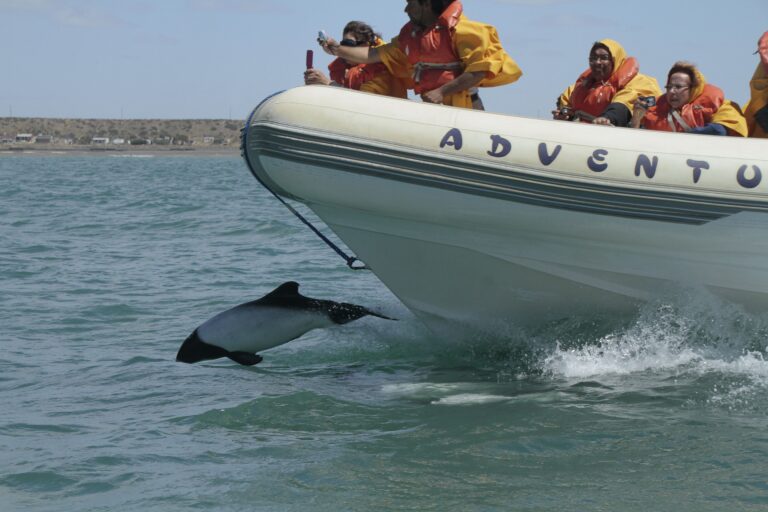
Commerson’s Dolphin Watching from Rawson Port
Enjoy a one-hour boat ride from Rawson to see Commerson’s dolphins, sea lions, and coastal birds in their natural habitat.
- Peninsula Valdes
From Price: USD 165
Conservation concerns
Living close to shore brings Commerson’s dolphins into the same narrow habitat used by fisheries, ports and recreational vessels. Documented concerns include accidental capture in fishing gear, disturbance from repeated vessel approaches, underwater noise, pollution and marine debris. Climate-driven changes in prey or coastal conditions may add pressure that is difficult to predict.
Genetic distinctiveness increases the value of local management. If a coastal group has limited exchange with neighboring groups, the loss of individuals or degradation of one habitat network can have consequences that are not quickly repaired by immigration.
Provincial Natural Monument since 2025
Chubut’s Law XI No. 93 declared the tonina overa a Provincial Natural Monument and part of the province’s natural cultural heritage in 2025. The law also calls for a provincial register containing scientific information, threats and protection strategies. The declaration recognizes that this animal is not only a tourism symbol but a protected component of Chubut’s identity.
The same law protects the southern giant petrel and several other native marine species, reinforcing the idea that conservation must address an ecosystem rather than one charismatic animal.
What responsible dolphin watching looks like
- Choose authorized operators and follow crew instructions.
- Let the dolphins decide whether to approach the vessel.
- Do not demand that the captain chase or circle a group.
- Avoid loud reactions when animals are close.
- Never throw food into the water.
- Keep hands, cameras and loose items secure inside the boat.
- Accept that weather or wildlife behavior may shorten or cancel an encounter.
In travel planning, I always separate “the species lives here” from “a sighting is guaranteed today.” Wind, sea conditions, prey and the dolphins’ own movements determine the experience. A responsible operator protects the animals by making conservative decisions even when that disappoints a passenger.
Puerto Madryn – 2 night traditional program
Check best season to see whales and penguins in the area
Photography without losing the biology
Use a fast shutter speed and continuous autofocus, but do not spend the entire encounter looking through the viewfinder. The black-and-white pattern can fool exposure systems; preserve detail in the white body rather than brightening every frame. Wider images showing the river mouth, current or vessel context often explain more than a cropped dorsal fin.
Photographs can also support responsible interpretation. A clear sequence may show a calf, scars, group spacing or direction of travel. Do not share imagery that encourages unauthorized close approaches.
A coastal specialist, not just a colorful dolphin
Commerson’s dolphins are shaped by the dynamic coastal waters of Patagonia. Their compact body, flexible diet, small-group behavior and localized population structure all connect them to the bays and estuaries of Chubut. The best wildlife experience recognizes that ecological story and gives the dolphins control over the distance.
Our team can help combine an authorized Rawson dolphin excursion with the broader Península Valdés itinerary, while keeping operating dates, transfers and wildlife expectations realistic.
Puerto Madryn & Puerto Piramides – 3 nights
Check best season to see whales and penguins in the area