
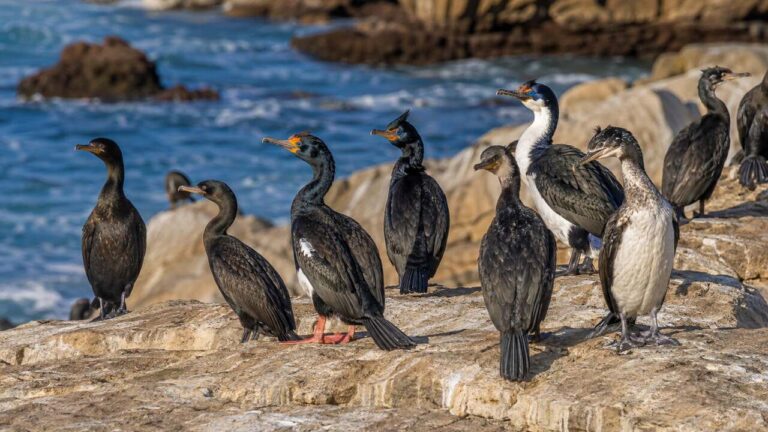
Cormorants are among the most visible seabirds on the Chubut coast, but identifying them is more demanding than simply recognizing a dark bird perched on a rock. Five species breed along the Argentine coast, and several can occur in the same Chubut landscape: imperial, rock or Magellanic, red-legged, neotropic and Guanay cormorants. Distance, wet plumage, age and breeding condition can all change what the observer sees.
This guide uses structure, face pattern, underpart color, leg color and habitat together. Taxonomic names vary between modern checklists and older regional literature, so both current and familiar scientific combinations may appear in field guides.
Quick comparison of Chubut’s cormorants
| Species | Best field marks | Typical setting | Common confusion |
|---|---|---|---|
| Imperial Leucocarbo atriceps |
Large; black-and-white; white cheek and neck; colorful facial skin in breeding adults | Large coastal colonies, islands, open marine water | Rock and Guanay cormorants |
| Rock / Magellanic Leucocarbo magellanicus |
Smaller; black head and upperparts, white belly; dark thighs; red facial skin | Rocky cliffs, ledges and nearshore feeding | Small imperial cormorant |
| Red-legged Poikilocarbo gaimardi |
Gray body, conspicuous red legs and feet, red bill base, pale neck patch | Sea cliffs and rocky coast, locally distributed | Usually distinctive when leg color is visible |
| Neotropic / Biguá Nannopterum brasilianum |
Mostly dark, slim, long-tailed; yellowish throat skin | Estuaries, ports, lagoons, rivers and coast | Dark juvenile cormorants |
| Guanay Leucocarbo bougainvilliorum |
Black head and upperparts, white underparts; reddish facial skin; white thigh area | Marine colonies and productive coastal waters; more localized | Imperial cormorant |

Imperial cormorant
The imperial cormorant is the large, abundant black-and-white species most visitors associate with Patagonian seabird colonies. Adults have a black back, white underparts and extensive white on the cheeks and sides of the neck. During breeding, the face becomes more colorful, with an obvious eye ring and fleshy areas around the bill. Immatures are browner and less sharply patterned.
Use overall size, the pale head-and-neck pattern and colony context. Imperial cormorants often form dense nesting groups and feed offshore, sometimes in large flocks.
Rock or Magellanic cormorant
The rock cormorant is smaller and more compact. Adults show black upperparts and white underparts, but the head and much of the neck remain dark, producing a cleaner black hood than on the imperial cormorant. Red bare skin is visible around the face at close range. The thighs are dark, an important distinction when comparing it with Guanay cormorants.
This species is strongly tied to rocky coasts. It nests on narrow cliff ledges and often feeds closer to shore than the imperial cormorant. At Punta Loma, rock and imperial cormorants can provide a useful direct comparison from the authorized viewpoint.
Birdwatching Whole Day Tour
Embark on a full-day birdwatching adventure in Patagonia, discovering the diverse avian species of the Peninsula Valdés region.
- Puerto Madryn
From Price: USD 1290
Red-legged cormorant
The red-legged cormorant is the most visually distinctive member of the group. Its plumage is largely gray rather than black-and-white, and the legs and feet are vivid red. The base of the bill is also reddish, while a pale patch marks the side of the neck. It is a cliff-nesting species with a patchier distribution, so observers should not assume it will be present at every colony.
Because the legs can be hidden while swimming or sitting, confirm the gray body and facial pattern before relying on the species name.
Neotropic cormorant or biguá
The neotropic cormorant is an adaptable, mostly dark species found in both marine and freshwater environments. Compared with the heavy marine shags, it appears slimmer and longer-tailed. Yellowish throat skin can be visible, particularly at close range. It may occur around estuaries, ports, the Chubut River, sheltered bays and lagoons as well as the open coast.
A dark juvenile imperial or rock cormorant can cause confusion. Structure and setting help: look for the biguá’s proportionally longer tail and more uniformly dark plumage.
Guanay cormorant
The Guanay is a Pacific-associated cormorant that also breeds at localized sites along the Argentine coast. It is black above and white below, with reddish facial skin and pale thighs. From a distance it can resemble an imperial cormorant, but the darker head-and-neck pattern and face are different. Its occurrence is less predictable for the average Península Valdés visitor, making careful documentation valuable.
Do not identify every black-and-white bird as Guanay simply because the neck looks dark in shadow. Obtain photographs showing the face, thighs and side profile.
The Isla de los Pájaros visitor guide explains how to observe a mixed protected colony from the shore. Its optics and intertidal setting make it a useful place to practice patient identification without approaching nests.
Why wet plumage and age cause mistakes
Cormorants do not always look like a field-guide plate. Wet feathers become darker and can reduce visible contrast. Strong backlight can erase white underparts, while reflected water can create false pale areas. Juveniles are generally browner and less crisply patterned than adults. Breeding facial colors fade outside the nesting period.
Use a sequence: size and structure, head pattern, underparts, thigh color, legs, face and habitat. No single clue should carry the entire identification when the bird is distant.
Puerto Madryn – 2 night traditional program
Check best season to see whales and penguins in the area
Behavior that helps identification
All cormorants dive for food, sit low in the water and may hold their wings open while resting. More useful differences come from foraging zone and colony structure. Rock cormorants frequently work near rocky shores; imperial cormorants can form larger offshore feeding groups; neotropic cormorants readily use estuaries and inland water; red-legged cormorants are strongly associated with sea cliffs.
Behavior supports an identification but does not prove it. Birds move, and mixed-species roosts are common.
Responsible viewing at colonies
- Remain behind barriers and use established viewpoints.
- Never climb toward a cliff nest or launch a drone over a colony.
- Avoid playback and food attraction.
- Use binoculars or a scope before attempting photographs.
- Watch for repeated head-turning, alarm postures or birds leaving nests.
- Keep plastic, fishing line and food waste secured.
I recommend that travelers photograph the entire bird before concentrating on the face. A full side view preserves size, posture, thigh color and habitat—the exact evidence needed when two similar species must be separated later.
Turning a common sight into a better observation
Cormorants deserve more than the label “black seabird.” Learning five silhouettes and a handful of field marks transforms every Chubut viewpoint into an identification exercise. Begin with the expected imperial and rock cormorants, recognize the all-dark biguá, then treat red-legged and Guanay cormorants as more localized possibilities requiring stronger evidence.
For a trip with dedicated birdwatching time, our team can help combine public viewpoints, coastal habitats and realistic travel distances without compromising protected colonies.
Puerto Madryn & Puerto Piramides – 3 nights
Check best season to see whales and penguins in the area
Puerto Madryn & Peninsula Valdes – 3 night traditional program
Check best season to see whales and penguins in the area


