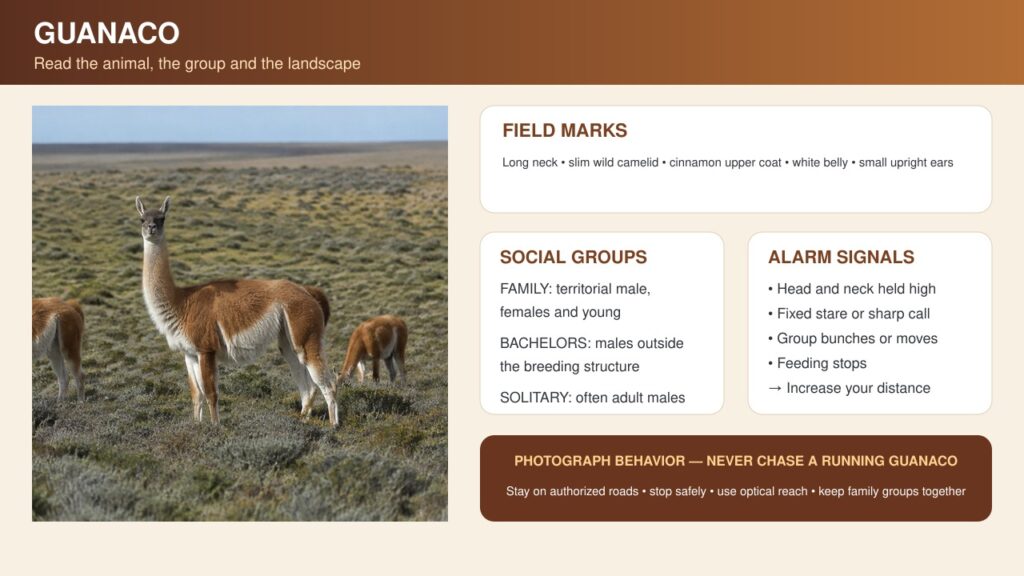
Guanacos are the largest native land mammals most visitors regularly see in Península Valdés. These wild South American camelids live in the Patagonian steppe year-round and can appear beside internal roads, across open plains or near estancia land. Their cinnamon-and-white coat, long neck and alert posture make adults easy to recognize, but understanding their social groups turns a quick sighting into a much richer wildlife experience.
They are widespread, not guaranteed at a particular kilometer marker. Scan open ground slowly, use binoculars and give every group enough space to continue feeding or moving naturally.
How to identify a guanaco
A guanaco has a slim but powerful body, long legs, a long neck and relatively small upright ears. The upper body is warm tan to cinnamon, while the belly and inner legs are pale. The face is grayish, often with darker tones around the muzzle. Unlike domestic llamas, wild guanacos have a consistent, understated coat pattern rather than a wide range of colors and wool types.
| Observation | Likely meaning |
|---|---|
| Adult male with several females and young | Territorial family group |
| Group of similarly sized animals without small young | Possible bachelor group |
| One animal standing tall while others feed | Vigilance or sentinel behavior |
| Neck extended and group moving away | Disturbance is increasing; allow more distance |
Peninsula Valdes from La Elvira Lodge
Visit Península Valdés from a hotel built 20 years ago, which was restored and transformed into La Elvira Natural Lodge, located within the peninsula.
Family groups, bachelor groups and solitary males
Guanaco society is not one uniform herd. Family groups generally contain an adult territorial male, adult females and their young. Separate bachelor groups contain males that are temporarily outside the breeding structure. Solitary males may hold territories or move between groups.
This organization explains why two sightings on the same day can look very different. A compact family group may feed within a defended area, while a larger, looser group of males moves across the steppe. Group size changes with habitat, season, food distribution and disturbance.
Feeding and adaptation to dry Patagonia
Guanacos are flexible herbivores that consume grasses and woody plants. That broad diet helps them live in the arid and semi-arid landscapes that dominate Patagonia. Their padded feet are well suited to firm, dry ground and are gentler on soil than hard hooves.
Feeding animals repeatedly lower and raise their heads. One member may remain alert while others graze. This is the moment to watch rather than advance: when the group relaxes, natural interactions become visible.
Artisanal Fishery at The Gulf of San José
Step aboard a traditional fishing boat and discover the secrets of artisanal fishing passed down through generations in the heart of Peninsula Valdés.
- Puerto Madryn
From Price: USD 1290
Alarm behavior and communication
An alert guanaco may freeze, stare, raise its head and give a sharp alarm call. Family members then bunch together or move away. Guanacos can run quickly across uneven ground and clear fences, but fencing also creates a collision and entanglement risk, particularly for younger animals.
Never use a vehicle to pace a running guanaco. If an animal is beside the road, slow early and give it time to choose its direction. A panicked crossing is dangerous for wildlife and passengers.
Where to see guanacos in Península Valdés
Look across the open interior between the Istmo Carlos Ameghino and the main wildlife sectors, including routes toward Puerto Pirámides, Caleta Valdés and Punta Norte. They may also occur on estancia land where access is controlled. Guanacos stand taller than the surrounding scrub, so their necks and ears often appear before the full body.
Morning and late afternoon provide attractive light, but guanacos can be visible throughout the day. Wind may push groups into more sheltered terrain. Use pullouts and authorized stops; the shoulder of a gravel road is not automatically safe.
The site’s guide to wildlife by month in Península Valdés helps place land-mammal sightings alongside whale, penguin and marine-mammal seasons.
Guanaco or llama?
- Guanaco: wild, slender, consistent tan-and-white coat, short body hair and adapted to open native habitat.
- Llama: domesticated, usually heavier, with much greater variation in color, pattern and fleece.
- Vicuña: smaller and more delicate, associated primarily with high Andean environments rather than coastal Chubut.
Photography: behavior first, portrait second
A moderate or long telephoto lens is ideal. Begin with a wider frame that shows the animal within the steppe, then make tighter portraits if distance and conditions permit. Focus on the eye, use a shutter speed appropriate for sudden movement and avoid positioning the sun directly behind a dark face unless you want a silhouette.
Watch for visual stories: an alert adult above low scrub, a family moving in line, interaction between a mother and young, or a guanaco framed against the open peninsula. These images communicate Península Valdés better than a tightly cropped head alone.
In my experience planning wildlife trips, the strongest photographs often come after the vehicle has been still for several minutes. The animals resume their own rhythm, and the scene stops looking like a roadside interruption.
For general equipment and light advice, connect this species guide with the wildlife photography opportunities in Península Valdés.
Ethical viewing checklist
- Stay on authorized roads and paths.
- Never feed, call or chase guanacos.
- Do not block a group’s line of travel or separate a young animal.
- Reduce speed near animals and fences.
- Use binoculars or a telephoto lens instead of closing the distance.
- If heads rise and feeding stops because of you, back away.
Peninsula Valdes from La Elvira Lodge
Visit Península Valdés from a hotel built 20 years ago, which was restored and transformed into La Elvira Natural Lodge, located within the peninsula.
Why guanacos matter to the landscape
Guanacos are native grazers, prey for large carnivores and a central part of Patagonia’s ecological history. Their populations can be locally abundant, yet fencing, road collisions, habitat fragmentation and conflict with livestock production remain important pressures. Seeing them as functioning wild animals—not background scenery—is the responsible way to visit.
A guided Península Valdés day improves the chance of recognizing group structure and safe stopping places. If wildlife photography or terrestrial fauna is a priority, tell PeninsulaValdes.com when requesting an itinerary so the pace can be planned around observation rather than only the major coastal viewpoints.
The animal that gives scale to the steppe
A guanaco standing alone can make the peninsula’s open interior feel enormous. Look beyond the first animal: find the rest of the group, notice who is watching and wait for the landscape to settle. That patience is what turns identification into wildlife understanding.
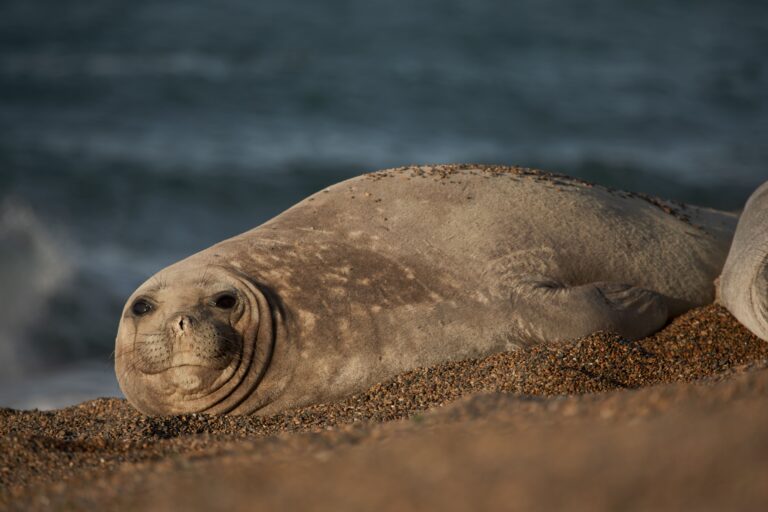
Elephant Seals: Giants of the South
Witness the awe-inspiring presence of elephant seals on an unforgettable coastal adventure through Patagonia.
- Peninsula Valdes
From Price: USD 1190
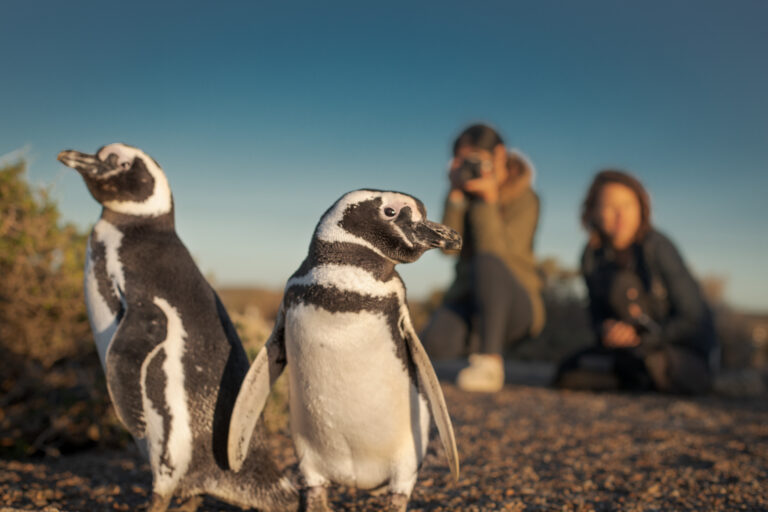
Private Penguin Colony Tour from Puerto Madryn
A unique penguin encounter in Península Valdés, far from the crowds.
- Peninsula Valdes
From Price: USD 1190