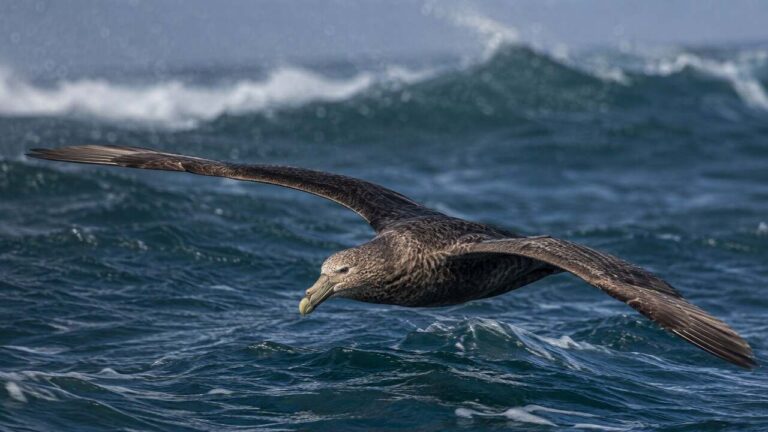
The southern giant petrel is one of the most impressive seabirds visible along the Chubut coast. With a wingspan approaching two meters, a heavy hooked bill and a flight style that alternates powerful wingbeats with long, wind-supported glides, it can look almost albatross-like at first. Around Península Valdés, giant petrels may be seen from coastal viewpoints or boats, especially where wind, currents and food bring seabirds close to shore.
This is not simply a visitor’s identification challenge. The southern giant petrel (Macronectes giganteus) breeds on islands off Chubut, and in 2025 the province declared it a Provincial Natural Monument. Seeing one should therefore lead naturally to a conversation about feeding ecology, nesting sensitivity and responsible seawatching.
How to identify a southern giant petrel
Size is the first clue. The bird is substantially bulkier than the smaller petrels and shearwaters that cross the same waters. Its bill is massive, pale yellowish to horn-colored, divided into visible plates and finished with a hooked tip. Like other tubenoses, it has a prominent nasal tube above the bill.
Dark-morph adults are gray-brown with a paler, increasingly mottled head and neck. Juveniles can be uniformly dark chocolate-brown and are much harder to distinguish from northern giant petrels. A rare white morph—white with scattered dark feathers—belongs to the southern species, but most birds seen in Chubut will not provide that easy clue.
| Clue | Southern giant petrel | Caution |
|---|---|---|
| Structure | Huge petrel, thick body, broad wings, massive hooked bill | Size judgment is difficult without comparison |
| Bill tip | Typically greenish | Light, distance and age can obscure color |
| Plumage | Dark brown juvenile; paler-headed adult; rare white morph | Dark juveniles overlap strongly with northern giant petrels |
| Flight | Heavy wingbeats followed by low, controlled glides | Wind can alter apparent flight style |
Southern or northern giant petrel?
The safest field distinction between adult giant petrels is the bill-tip color: greenish on southern giant petrels and reddish on northern giant petrels. In practice, this is often invisible from shore. Plumage alone is unreliable, particularly in dark juveniles. A series of sharp photographs showing the bill from several angles is more useful than one distant silhouette.
Do not force every giant petrel into a species name. Recording “giant petrel species” is better than a confident but unsupported identification. The white morph is an exception: it is associated with the southern giant petrel.
Peninsula Valdes from La Elvira Lodge
Visit Península Valdés from a hotel built 20 years ago, which was restored and transformed into La Elvira Natural Lodge, located within the peninsula.
Where can travelers see them?
Giant petrels range widely over coastal and open water. Around Península Valdés, productive places to scan include elevated viewpoints at Punta Loma, Punta Pirámide, Caleta Valdés and other authorized coastal stops. Boat trips may also produce encounters, but the species is never guaranteed.
Wind direction matters. Onshore winds can bring pelagic birds closer to headlands, while calm conditions may make distant birds easier to follow through a spotting scope. Search behind fishing activity, near marine-mammal colonies and along tide lines, but remember that access rules and safe viewing areas take priority over birding conditions.
At Punta Loma Nature Reserve, the public experience is from designated cliff-top viewpoints. Use those same protected positions for seawatching rather than seeking an unofficial edge.
Feeding behavior: predator and scavenger
Southern giant petrels have a broader feeding role than many travelers expect. At sea they take fish, squid and other marine prey. They also scavenge carrion and may feed around seal and penguin colonies, fisheries or vessels. On land and at the water surface they can behave as forceful predators. This combination has earned them an unfairly sinister reputation, but scavenging is an essential ecological service that recycles nutrients and removes carcasses.
Males and females differ in average size and can use food resources differently, but sex is not usually identifiable during a casual field sighting. The most informative behavior to watch is how a bird uses wind and water: low gliding, surface investigation, landing near food and strong takeoff runs all show its adaptation to a marine environment.
Birdwatching Whole Day Tour
Embark on a full-day birdwatching adventure in Patagonia, discovering the diverse avian species of the Peninsula Valdés region.
- Puerto Madryn
From Price: USD 1290
Breeding on the Chubut coast
Southern giant petrels breed in widely spaced colonies on ice-free coasts, open ground and offshore islands. Chubut supports breeding sites of international importance. A pair normally lays one egg, and both adults share incubation and chick care. This slow reproductive strategy means disturbance or loss at a colony cannot be replaced quickly.
Nesting islands are not visitor attractions unless access is explicitly authorized and managed. Boats should not approach colonies for a closer photograph. Adults may leave a nest when disturbed, exposing an egg or chick to cold, heat, predation or conflict with neighboring birds.
Conservation status and the 2025 Chubut declaration
Global assessments have changed as monitoring improved, and the species is currently treated more favorably than it was in older literature. Local threats still matter: fisheries interactions, ingesting or becoming entangled in marine debris, contaminants, disturbance at breeding sites and changes in food availability can all affect populations.
Chubut’s Law XI No. 93, enacted in 2025, declared the southern giant petrel a Provincial Natural Monument and part of the province’s natural cultural heritage. For visitors, the practical meaning is straightforward: this is a specially protected native species, not a bird to attract with food, chase by boat or crowd at a nest.

Seawatching and photography tips
- Use binoculars for detection and a spotting scope for distant bill detail.
- Choose a fast shutter speed for birds crossing irregular wind.
- Track the bird before pressing the shutter; erratic panning loses both focus and observation time.
- Photograph several angles if identification is uncertain.
- Keep food and waste secured; never throw scraps to draw birds closer.
- Respect barriers and instructions from rangers or boat crews.
From a travel-planning perspective, giant petrels reward flexibility. They are a valuable secondary target while visiting marine-mammal colonies and coastal viewpoints, but a dedicated birder should allow repeated scanning time rather than expect one scheduled stop to produce a close bird.
A seabird that connects land and ocean
The southern giant petrel is both a long-distance ocean traveler and a breeding bird of Chubut’s offshore islands. Its hooked bill, vast wings and scavenging behavior tell a story about survival in windy, productive seas. Identify carefully, watch from authorized places and treat every sighting as part of a larger protected coastal system.
Our team can help integrate birdwatching into a Península Valdés itinerary alongside the region’s better-known wildlife, with realistic expectations about weather, distance and unpredictable seabirds.
Peninsula Valdes from La Elvira Lodge
Visit Península Valdés from a hotel built 20 years ago, which was restored and transformed into La Elvira Natural Lodge, located within the peninsula.
Puerto Madryn & Puerto Piramides – 4 nights
Check best season to see whales and penguins in the area