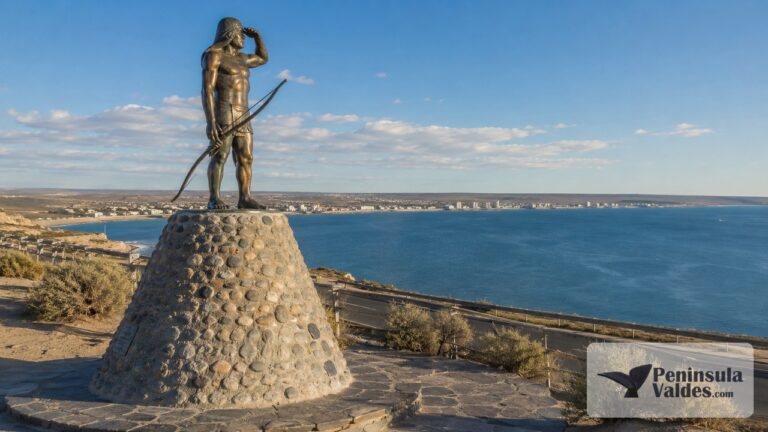
The Monumento al Indio Tehuelche is an open-air landmark on the southern edge of Puerto Madryn, above Punta Cuevas and Golfo Nuevo. Visitors come for the broad view over the bay, but the monument also raises an important historical point: Indigenous peoples lived across Patagonia long before the Welsh settlers arrived in 1865, and Tehuelche communities remain part of the region’s identity.
The viewpoint is free and does not require a ticket or formal opening time. It can be visited during a coastal walk or short drive from central Puerto Madryn and combines naturally with Punta Cuevas, the Museo del Desembarco and Ecocentro. Allow 15 to 30 minutes for the monument alone, longer if you walk the historical coastal circuit.
Where is the monument?
The monument stands beside Boulevard Almirante Brown in the Punta Cuevas area, south of the main urban beaches. It occupies an elevated coastal position facing Golfo Nuevo. From central Puerto Madryn, travelers can arrive by taxi, bicycle, private vehicle or a long waterfront walk.
The monument is often called simply “El Indio” locally. The surrounding landmark may also appear on maps as Punta del Indio or near the Punta Cuevas historical park. Use the official attraction name when searching because similarly named Indigenous monuments exist elsewhere in Patagonia.
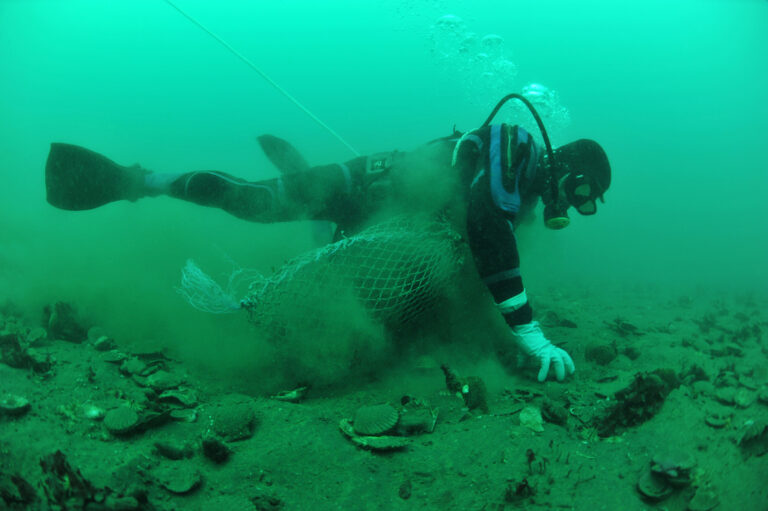
Artisanal Fishery at The Gulf of San José
Step aboard a traditional fishing boat and discover the secrets of artisanal fishing passed down through generations in the heart of Peninsula Valdés.
- Puerto Madryn
From Price: USD 1290
What does the sculpture represent?
The standing figure shades his eyes with one hand while holding a long bow in the other, looking toward the gulf. It is a symbolic Tehuelche figure rather than a portrait of a documented individual. The work should not be read as a complete history of Indigenous Patagonia; it is a mid-20th-century public monument shaped by the artistic and commemorative language of its time.
Today, a responsible visit means looking beyond the statue’s silhouette. Tehuelche is a broad historical label applied to different peoples of Patagonia, including groups often identified as Aonikenk in southern areas. Their histories did not end when Europeans arrived. Indigenous identities, families, cultural practices and claims continue in Patagonia.
Puerto Madryn & Ushuaia
Check best season to see whales and penguins in Puerto Madryn and Peninsula Valdes area
Who created the Monumento al Indio Tehuelche?
The monument was designed by Argentine sculptor Luis Perlotti, known for public works depicting Indigenous and regional subjects. Its project is associated with 1965, the centenary year of the Welsh landing in Chubut, when Perlotti was also involved with commemorative work in Puerto Madryn.
Online accounts disagree about the exact distinction between construction, placement and formal inauguration. Some describe it as inaugurated in 1965, while another detailed local history says it was placed later and formally inaugurated in 2004. The safest editorial wording is that the design dates from the 1965 commemorative period, without presenting a disputed ceremonial date as certain.
After decades facing salt, wind and weather, the monument underwent restoration and returned to its original site in December 2022. The work addressed fissures and instability in both the sculpture and its base.
Why is the location historically important?
The viewpoint sits above Punta Cuevas, associated with the arrival of 153 Welsh settlers aboard the Mimosa on July 28, 1865. The nearby caves and historical interpretation focus on that landing. The Tehuelche monument adds a necessary earlier and parallel perspective: Patagonia was already inhabited, understood and traveled by Indigenous communities.
Do not reduce the story to a simple “first people helped later settlers” anecdote. Relationships involved exchange, knowledge, negotiation and conflict, and they developed over time. A good historical itinerary uses the monument as the beginning of questions, then visits the nearby museum for a fuller account.
What can you see from the viewpoint?
The outlook covers Golfo Nuevo, the Puerto Madryn waterfront, beaches and the arc of the bay. Clear light is often best in the morning or late afternoon, but wind and haze can change visibility quickly. The position is excellent for understanding how the city occupies a protected gulf rather than an open-ocean coast.
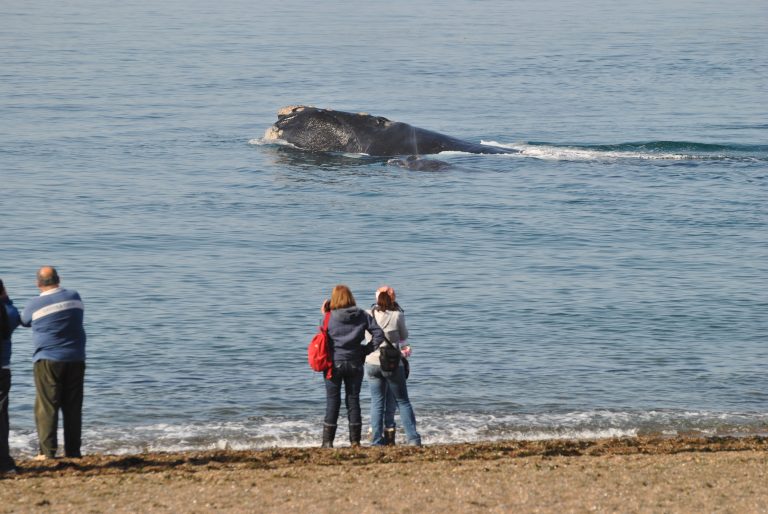
Southern right whales may be visible in Golfo Nuevo during the broad June-to-December season, but this is not a guaranteed whale-watching platform. Bring binoculars, scan slowly and never confuse a distant dark shape or breaking wave with a confirmed animal.
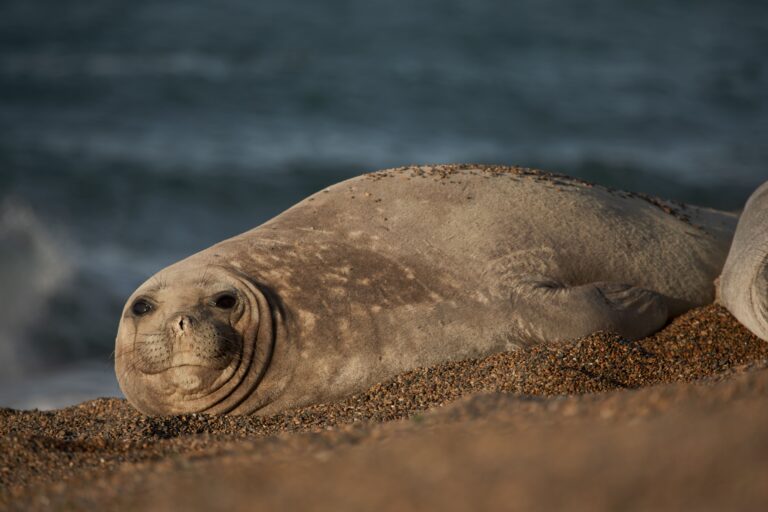
Elephant Seals: Giants of the South
Witness the awe-inspiring presence of elephant seals on an unforgettable coastal adventure through Patagonia.
- Peninsula Valdes
From Price: USD 1190
Best time to visit
Morning
Morning often brings clear views and less traffic. It suits travelers combining the monument with Punta Cuevas before museums or excursions open.
Late afternoon
Low light gives the sculpture and cliffs more texture. Sunset times vary strongly by season, and the exposed viewpoint can become cold quickly after the sun drops.
Windy days
The monument remains visually impressive, but the exposed setting may be uncomfortable. Keep hats, phones and camera equipment secure. Do not move toward cliff edges to escape other visitors or improve a photograph.
How to combine the visit
- Punta Cuevas and Museo del Desembarco: continue directly into the Welsh-landing history beside the monument.
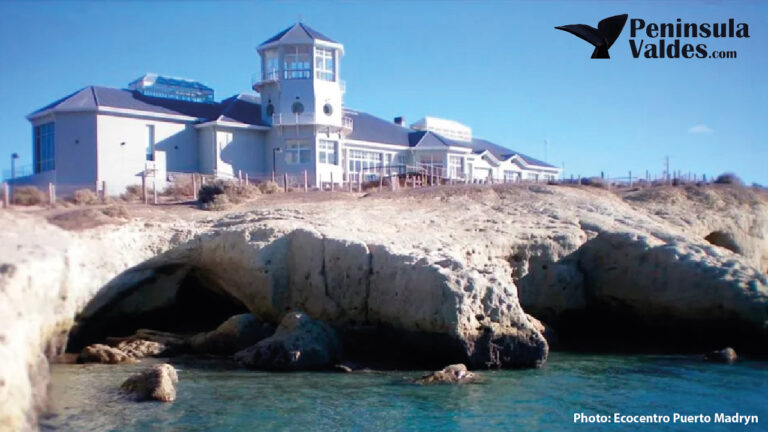
- Ecocentro Pampa Azul: add marine interpretation and another coastal viewpoint farther south.
- Playa Kaiser: continue along the southern shore when access, wind and daylight are suitable.
- Punta Loma: make the monument an early historical stop before the longer gravel-road drive to the sea lion reserve.
For a wider city itinerary, see what to do in Puerto Madryn. The monument works best as one layer in a coastal route, not as an isolated photo stop.
Accessibility and safety
The roadside viewpoint is easier to reach than the lower shoreline at Punta Cuevas, but surface conditions, curb transitions and parking arrangements can change. Travelers using wheelchairs or with limited walking ability should verify the most level approach locally. Do not assume the paths around the cliff and historical caves are step-free.
- Stay behind barriers and away from eroded cliff edges.
- Supervise children closely in wind and near traffic.
- Do not climb the monument or base.
- Use marked parking and avoid blocking the coastal road.
- Carry a windproof layer even on a sunny day.
Photography tips
A wide lens can include the figure, sky and curve of Golfo Nuevo. A longer focal length compresses the monument against the city or water. Position yourself on established surfaces and accept other visitors in the scene rather than stepping into unsafe areas. At midday, expose carefully for the statue so it does not become an unreadable silhouette.
Peninsula Valdes from La Elvira Lodge
Visit Península Valdés from a hotel built 20 years ago, which was restored and transformed into La Elvira Natural Lodge, located within the peninsula.
Frequently asked questions
Is there an entrance fee?
No. The monument and outdoor viewpoint are public and free to visit.
Is the monument always open?
It is an outdoor roadside landmark without museum-style opening hours. Visit in daylight for safer access and better interpretation of the surroundings.
Can you see whales from the monument?
Whales may be visible in Golfo Nuevo during the season, but sightings and distance vary. The monument is a scenic viewpoint, not a guaranteed whale observatory.
Is it the same place as Punta Cuevas?
They are neighboring attractions in the same coastal area. The monument is above the historical Punta Cuevas site and can be visited on the same outing.
Who was the person represented?
The sculpture is a symbolic Tehuelche figure, not a portrait of a named historical individual.
Artisanal Fishery at The Gulf of San José
Step aboard a traditional fishing boat and discover the secrets of artisanal fishing passed down through generations in the heart of Peninsula Valdés.
- Puerto Madryn
From Price: USD 1290